 Beth
and Marvin's Miata Vacation 1998

Click on any of the thumbnail pictures below for a larger version of the image.
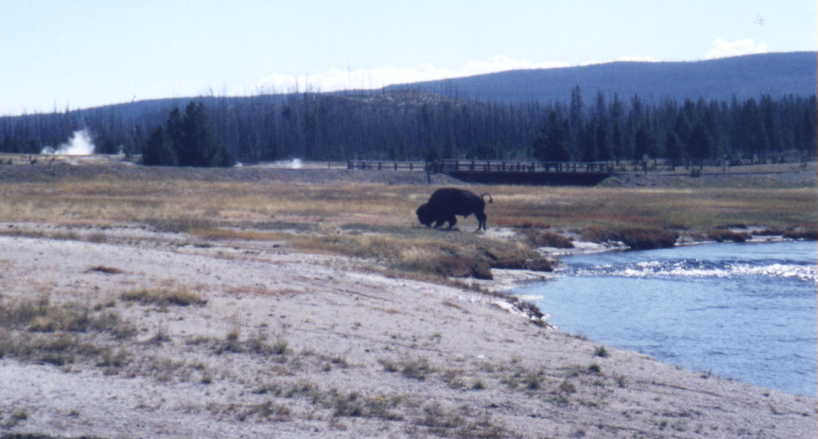 Yellowstone National
Park was the country's first national park and one of the largest
in the contiguous United States. Yellowstone contains more than 2
million acres which include many steaming geysers, brilliantly colored
hot springs, roaring waterfalls, and beautiful panoramic vistas. It is
also one of the world's foremost sanctuaries for wildlife such as deer,
elk, bison, wolves, and bears, as well as many varieties of birds, and
fish. This lone bison was seen near the Gibbon River, and several puffs
of steam reveal the location of thermal activity in the background.
We did see several other groups of bison while driving through the five geyser basins (West Thumb, Lower, Midway, Upper, and Norris) between the South Entrance and Mammoth Hot Springs (the road also crossed the Continental Divide 3 times). We pulled into the parking lot at Indian Creek to obeserve a group of bison, and two male bison were snorting, stamping and threatening to charge each other in the parking lot. I turned the Miata around immediately, as I figured a bison ramming into it wouldn't be very good for the Miata! But what really amazed me was that there were tourists standing and watching this display from no more than 20 feet away! No wonder there are accidents every year in which tourists are gored, sometimes fatally, by bison. Those bisons' fake charges at each other demonstrated to me that they could move extremely fast if they really wanted to. The second account from the "Stories from Records of the National Park System" page, details one tourist's encounter with a bison (Some of the other stories on the page are also funny, but tend to show humans can be pretty stupid at times).
We did stop at Old Faithful and walked around Geyser Hill while we waited for Old Faithful to erupt. It teased us for a while, but we finally got impatient and decided there were other things we wanted to see. So we went all the way to Yellowstone, and never saw Old Faithful erupt. Some tourists we turned out to be!
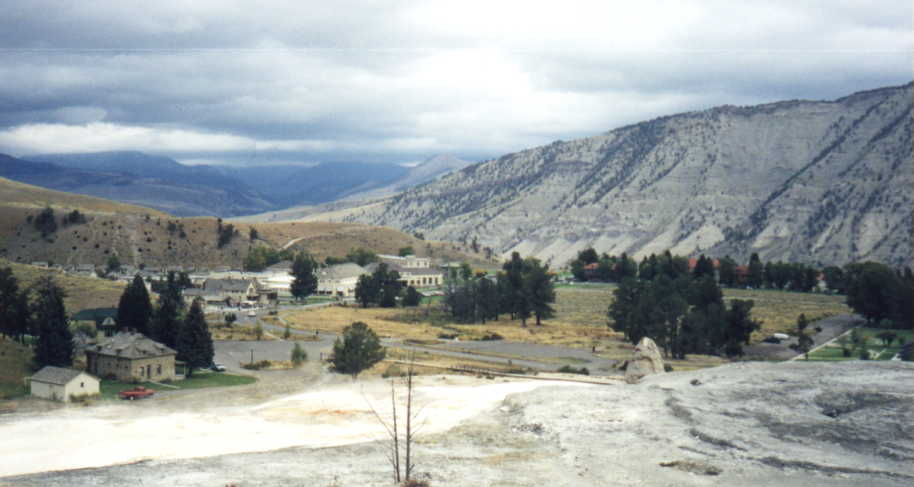 Mammoth
Hot Springs Lodge is located near the north-west entrance to the
park, just a couple of miles south of the Montana border. We had a
cabin reserved for a two night stay at the lodge, and it was far less
crowded than the Old Faithful lodging area. The large bluff to the east
(right side of the picture) is called Everts Mountain, and was named
after a member of the 1870 USGS exploring party who became separated
from the group and wandered for 37 days before being rescued. I'm real
glad Beth and I didn't have to wander that long when we got lost in
Devil's Garden!
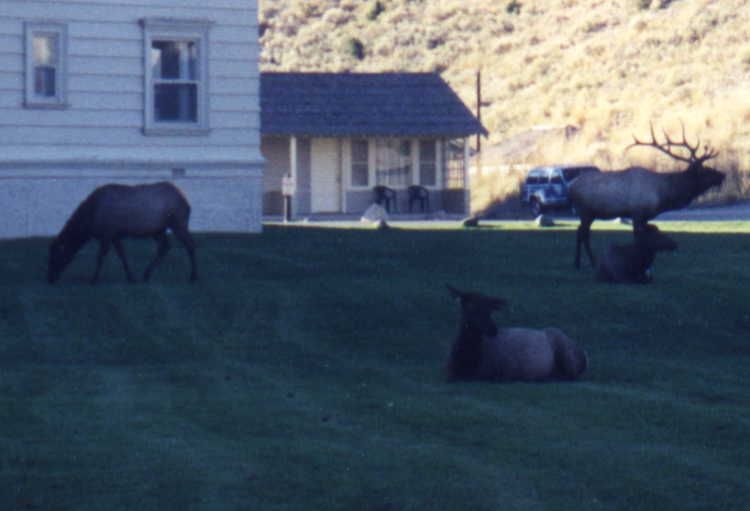 The
first surprise that greeted us upon arrival in Mammoth, was the number
of Elk lounging around the village. We arrived at the village late in
the afternoon to find this group fairly close to our cabin. The bull
elk in the background was "bugling", which begins with a low,
clear bellow, rises to a loud, high-pitched shrill, and ends with a
series of short grunts. The shrill portion of the noise really echoes
through the mountains and can be heard over long distances. Bull
bugling is heard mostly in the evenings during breeding season, and is
intended as a challenge to other bulls and a call of domination to cows.
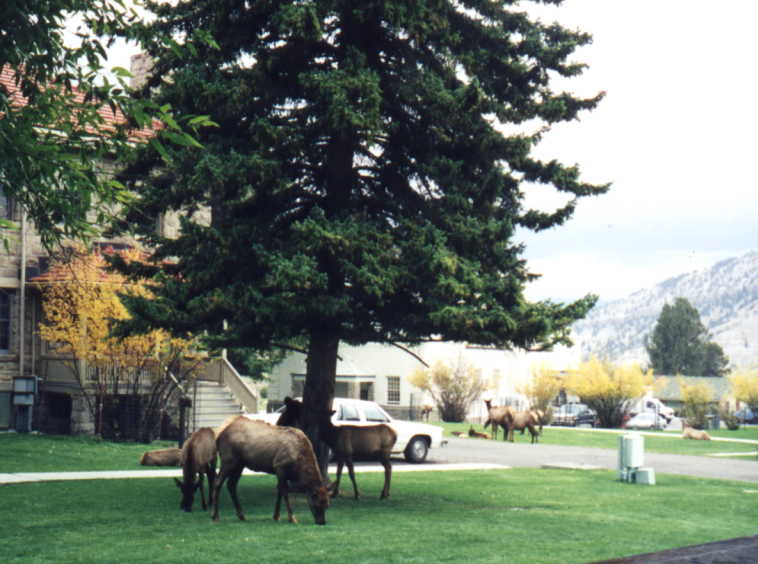
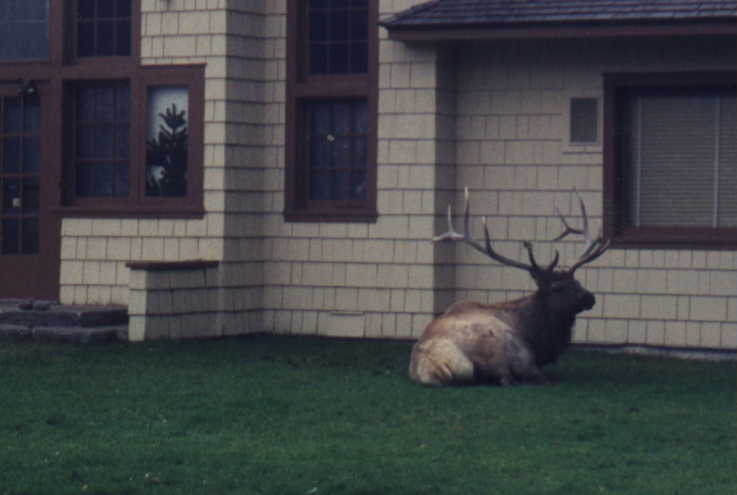 There
were at least two seperate herds of elk that hung around the village
during our 2 day stay. Here are two more images that show the elk seem
to know that they are the ones in charge. The large bull elk in the
picture on the right was laying right outside the park superintendant's
house, so maybe he really is in charge :-). These elk may look tame,
but when several teenage boys approached and bothered the younger elk
calves, it didn't take long for the bull elk to come over and
straighten them out. We were watching from the restaurant window, and
if the boys wouldn't have noticed several people in the restaurant
trying to warn them, they would have received a real big surprise when
the bull elk ended up right behind them! He sure didn't seem happy with
their antics.
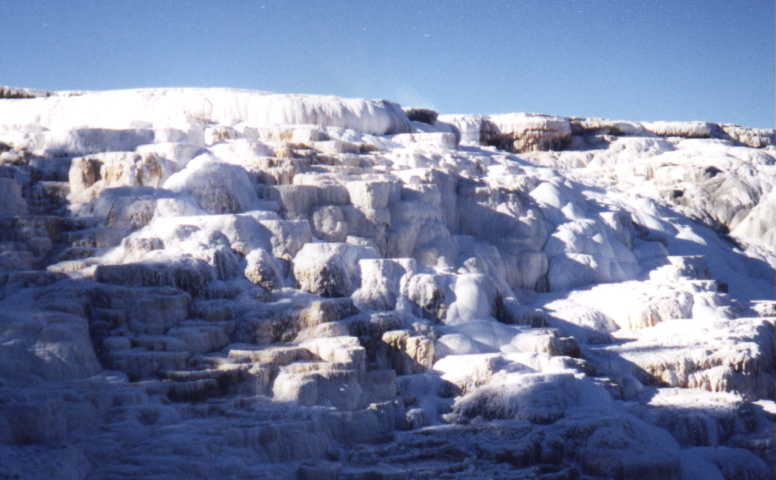
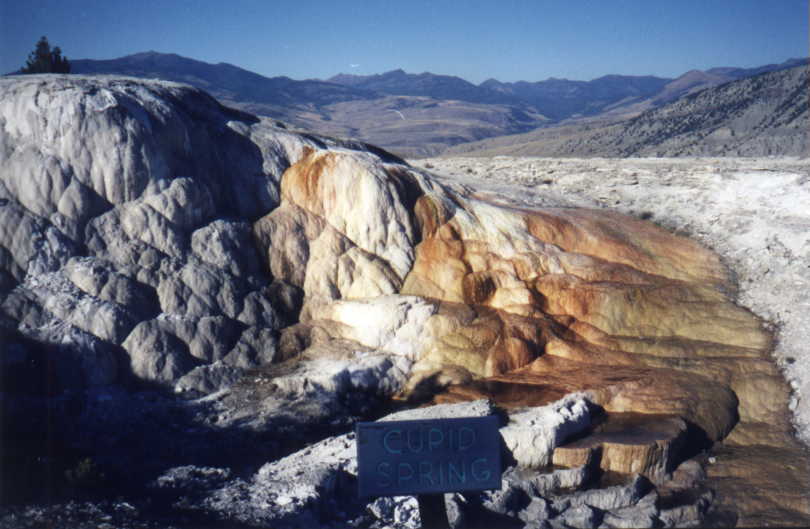 The
hot springs in the area form multi-colored terraces that are constantly
expanding and changing. The springs here are very different than the
geysers and hot pools found in the Geyser Basins. The deposits here are
made of limestone instead of silica, and they quickly build up into
large, beautiful formations. In doing so they choke off the water
supply and the spring moves elsewhere to form more terraces. Both of
these images were taken from the Upper Terrace Loop drive. The image on
the right is Cupid Springs, but somehow I forgot to write down the name
of the one on the left. I am guessing it is Angel Terrace, but if you
know for sure, send me some e-mail.
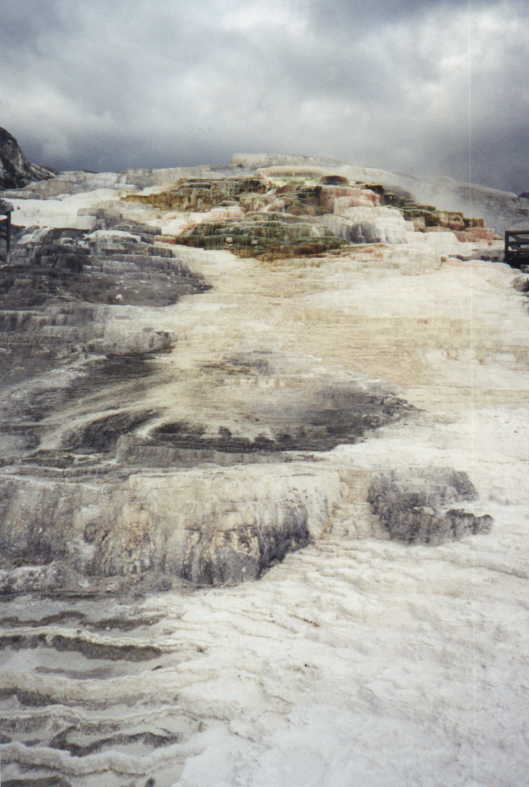
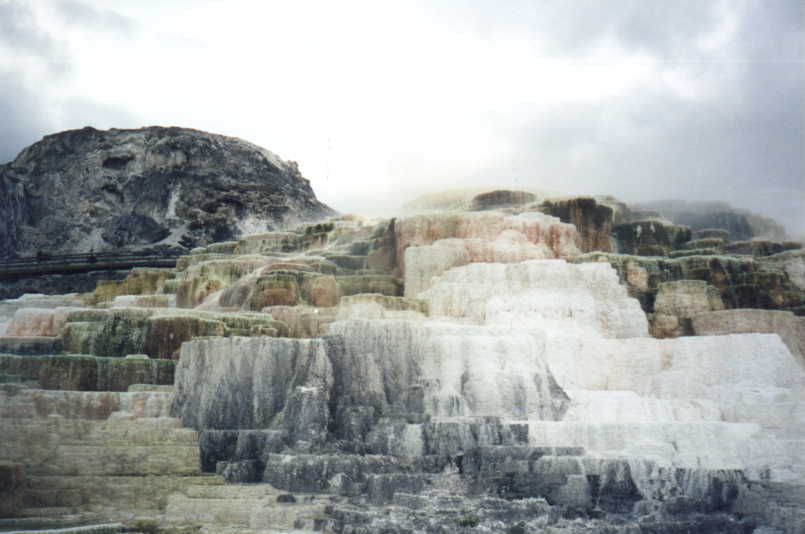 These
two images are of Minerva Terrace, which is located right in the center
of the Lower Terrace Trail. This spring is very popular with
photographers because of its wide range of bright colors and ornate
formations. Since 1890, when records were first kept, Minerva has gone
through both active and inactive periods. In the early 1900's it was
completely dry, but reports in the 1950's state that Minerva was active
again. During some cycles of activity, the water discharge and mineral
deposits were so great that the boardwalks of the Lower Terrace Trail
were buried beneath mounds of newly deposited travertine.
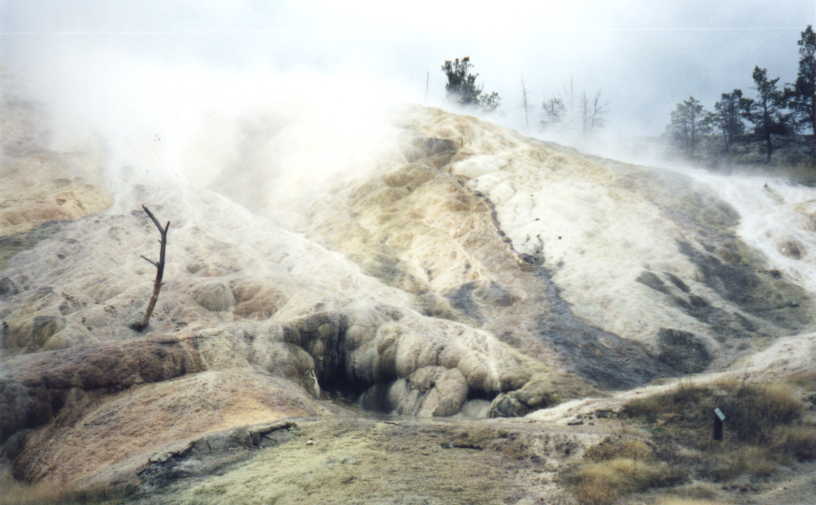 Water
flows from a flat area just above Palette Spring, down the steep ridge
creating a colorful hillside of brown, green, and orange. The various
colors are due to the different types of heat-tolerant bacteria present
in the water. It got it's name because an artist could achieve this
effect by just allowing wet paint to run down a vertical canvas. The
remnants of the dead tree on the left demonstrates the destructive
power these hot springs have on the surrounding vegetation when they
re-route to a new area.
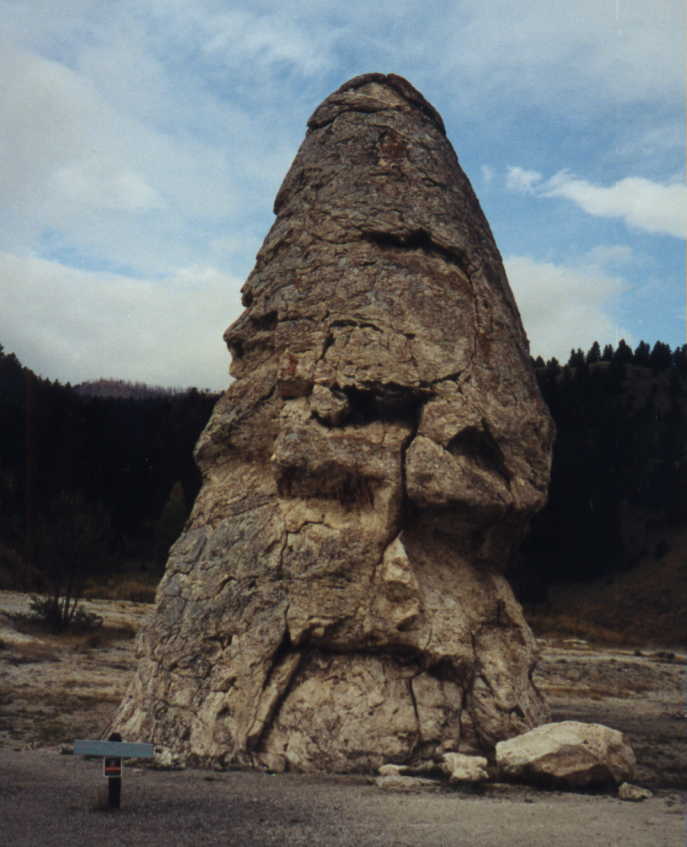 Liberty
Cap is a 37 foot (11 meter) hot spring cone that got it's name in 1871
because of its resemblance to peaked caps worn during the French
Revolution. It was created by a hot spring that remained active in one
location for an extremely long time. Its internal pressure was
sufficient to raise the water to a great height, allowing the mineral
deposits to build continuously for possible hundreds of years. It is
now dormant, and its outer surface has been cool and dry for many
years. You can also see evidence of the large chunk that broke off of
the formation in 1994.
You might have noticed that the pictures on this page were not taken on the same day (compare the sky in the first two terrace pictures as opposed to the Minerva and Palette Spring pictures). The latter pictures were taken during our third and very last morning in Yellowstone, and a storm had moved into the area by that time. But I am getting ahead of myself, we have a full day of hiking and fishing planned for our second day in Yellowstone.